Specifications
Full technical specifications of the Pengo 4K HDMI Grabber (B&H model
8RGRA-H01HU4T0PE), verified against the official Pengo v.9 and v.10 user
manuals, the Pengo Windows Tool v.190122, and cross-checked with
v4l2-ctl --all output on a Linux host.
Where the numbers come from
The spec tables on this page combine the manufacturer's published spec
sheet (in the user manual PDF and on B&H) with observed values from
v4l2-ctl on Linux 7.2.2 with the uvcvideo driver. Where they differ
it's noted explicitly.
Identification
| Field | Value |
|---|---|
| Manufacturer (USB string) | Pengo |
| Marketing product name | PENGO 4K HDMI Grabber |
| Internal product name (Windows Tool) | 4K Grabber |
| USB product string | Pengo HDMI Grabber |
| B&H SKU / model | 8RGRA-H01HU4T0PE / PE4KHDMIGRAB |
| USB Vendor:Product ID | 1e4e:701f (Cubeternet chipset) |
| Auxiliary chips (internal USB hub) | 048d:8595 and 048d:8950 (ITE IT5711 family) |
| Manufacturer | Pengo Technology Co., Ltd. (大海科技有限公司) |
| Manufacturer address | 33463 桃園市八德區榮興路533巷7弄13號 (Taiwan) |
| Manufacturer phone | +886-2-8791-1672 |
| Manufacturer fax | 55853973 |
| Manufacturer email | support@pengohome.com |
| Manufacturer web | pengohome.com (defunct — see Resources) |
| Linux driver | uvcvideo (built into kernel, no install needed) |
| Observed firmware | 190122 (via Pengo Windows Tool) |
| Observed hardware revision | 02 |
| UVC version | 1.0 / 1.1 compatible |
| UAC version | USB Audio Class 1.0 |
Inputs / Outputs
System connection
- USB-A 3.0 / 3.1 Gen 1 / 3.2 Gen 1 (5 Gbps)
- Backwards compatible with USB 2.0 — but expect severe frame drops; not recommended.
Video
- HDMI input: 1× HDMI type A (HDMI 2.0)
- HDMI loop output: 1× HDMI type A (HDMI 2.0 passthrough)
Audio
- 3.5 mm TRS microphone input (mono, mic level only — not line level)
- 3.5 mm TRS stereo headphone output (48 kHz, 16-bit)
- Embedded HDMI audio is carried on input, output, loop, and USB
Video format support
HDMI input (4:4:4 YUV sampling)
| Resolution | Refresh rates |
|---|---|
| 640 × 480p | 60 Hz |
| 1280 × 720p | 30 / 50 / 60 Hz |
| 1920 × 1080p | 24 / 25 / 30 / 50 / 60 Hz |
| 2048 × 1080 | 24 / 25 / 30 / 50 / 60 Hz |
| 3840 × 2160p (4K UHD) | 24 / 25 / 30 / 50 / 60 Hz |
HDMI loop output (passthrough)
Same as input — the loop is a clean bit-for-bit pass at the source's native resolution and frame rate.
USB-A output (UVC)
| Resolution | Refresh rates | Notes |
|---|---|---|
| 640 × 480p | 60 Hz | |
| 1280 × 720p | 30 / 50 / 60 Hz | |
| 1920 × 1080p | 24 / 25 / 30 / 50 / 60 Hz | Max practical mode |
The USB stream is downscaled from whatever HDMI signal is present, with a hard ceiling of 1080p60. There is no 4K over USB.
Observed UVC pixel formats (Linux v4l2-ctl --list-formats-ext):
[0]: 'MJPG' (Motion-JPEG, compressed)
     Size: Discrete 1920x1080
       Interval: Discrete 0.017s (60.000 fps)
       Interval: Discrete 0.033s (30.000 fps)
[1]: 'YUYV' (YUYV 4:2:2)
     Size: Discrete 1920x1080
       Interval: Discrete 0.017s (60.000 fps)
       Interval: Discrete 0.033s (30.000 fps)
MJPG vs YUYV
MJPG is compressed, easier on USB bandwidth, and gets you a stable 1080p60. YUYV is uncompressed and higher quality per frame but heavier on the bus. For AI / vision pipelines, MJPG is usually the right choice — vision models don't benefit from the slight chroma upgrade of YUYV.
Audio format
| Direction | Sample rates | Bit depth |
|---|---|---|
| Analog input (3.5 mm mic) | 44.1 / 48 / 96 / 192 kHz | 16-bit PCM |
| Analog output (3.5 mm headphone) | 48 kHz | 16-bit PCM |
| HDMI embedded | passthrough | passthrough |
| USB Audio Class | 48 kHz (commonly) | 16-bit |
Hardware & electrical
- Power: bus-powered via USB 3.0 — no separate PSU
- Reclocking: no
- HDCP: not supported (and cannot be bypassed)
- 1080i: not supported — interlaced sources will be black or garbled
- Latency: not officially specified; user reports describe it as "smooth, no perceived issue" for streaming and conferencing
Operating environment
| Operating temperature | 0 – 45 °C (32 – 113 °F) |
| Operating humidity | 20 – 90 % |
| Storage temperature | -20 – 60 °C (-4 – 140 °F) |
Physical
| Dimensions | 85.6 × 65 × 15.2 mm (3.4 × 2.6 × 0.6 in) |
| Weight | 91 g (3.2 oz) |
| Chassis material | Aluminium, titanium-grey finish |
| Packaging weight | 0.47 lb (213 g) |
| Box dimensions | 152 × 124 × 30 mm (6 × 4.9 × 1.2 in) |
System requirements (manufacturer)
| Minimum | |
|---|---|
| CPU | Intel i5 dual-core 2.8 GHz or higher |
| RAM | 4 GB |
| OS | Windows 8+ · macOS 10.13+ · Linux 2.6.38+ |
Linux 2.6.38 is from 2010 — basically every distribution in the last decade exceeds this by a wide margin.
What's in the box
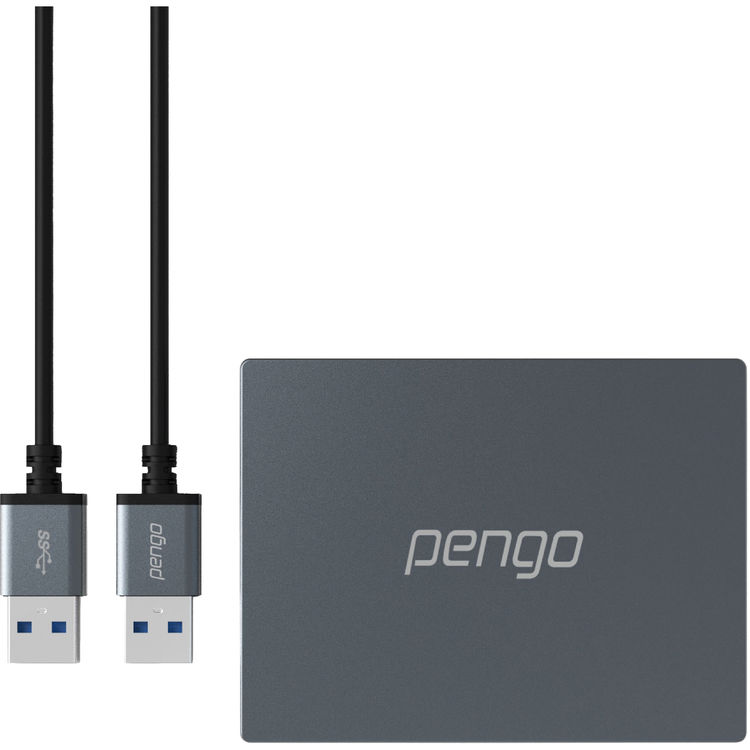
- 1× Pengo HDMI Grabber
- 1× USB 3.0 cable (USB-A to USB-A, proprietary; do not replace)
- 1× User manual (v.9, English)
- 18-month limited warranty card (with product registration at pengohome.com/register)
See Linux → Detection & drivers for what the kernel actually exposes.